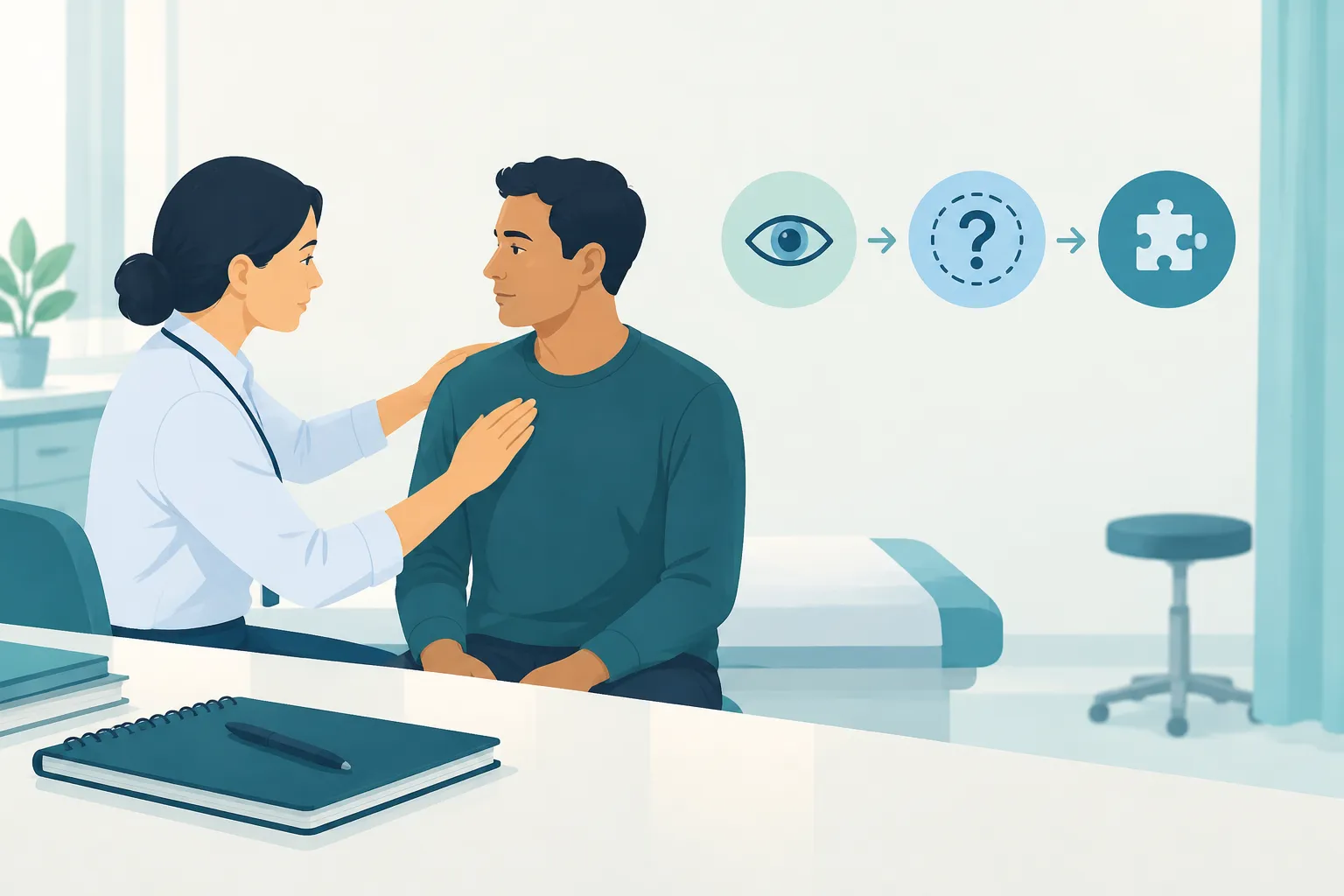
The examiner looks up from the mark sheet: “What are your findings?” You remember the likely diagnosis, but one physical sign is not quite clear. Calling it present might make the story fit. Saying nothing might feel like a failure.
How should you handle uncertain clinical signs in MRCP PACES? Report what you can confidently find, label the uncertain feature plainly, then interpret the case using the findings as a whole. A careful qualification is not a retreat from clinical judgement. It is part of it.
Use three moves: observe, qualify, interpret
Think of this as a practical speaking technique, not an official PACES formula. It keeps your answer honest and gives the examiner a clear view of your reasoning.
Observe: start with what you actually found
Lead with the findings you can defend. Name the important positive signs and the relevant negatives, using clear language. Avoid starting with a diagnosis and then selecting signs to support it.
If a feature is clearly present, state it directly. If it is clearly absent, say so. If your examination did not let you decide confidently, say that it was not demonstrated rather than converting uncertainty into either a definite positive or a definite negative.
That distinction matters. “There is no peripheral oedema” is a claim of absence. “I could not confidently identify peripheral oedema” describes the limit of your examination. Use the second only when that is what happened; do not hedge a finding that was clear.
Qualify: name the uncertainty, not your anxiety
Be precise about the doubtful feature. “The jugular venous pressure may be slightly raised, but I am not confident enough to call it a definite finding” is more useful than “I’m not sure about the whole examination.” The first tells the examiner which sign is uncertain and how much weight you are giving it.
If time and patient comfort permit, you can recheck the feature using the correct technique. Then move on. Repeatedly searching for a sign because a diagnosis seems to require it can make your examination less reliable, not more.
Interpret: let the findings set the limits
Now state what the examination supports—and what it does not establish. Give the leading interpretation, then a focused alternative if it changes your reasoning. Do not present an equivocal sign as the decisive evidence for a diagnosis.
A useful pattern is: “The definite findings are… This feature is uncertain, so I would not rely on it. Overall, the examination suggests…; I would also consider…” Keep the differential relevant to the patient in front of you rather than reciting a textbook list.
Why precision matters in PACES
PACES assesses physical examination, identification of physical signs and differential diagnosis as separate clinical skills. The examination guidance stresses that you should identify the agreed signs and avoid claiming signs simply to fit a presumed diagnosis. It also makes clear that confidence in the absence of a finding matters alongside recognition of positive signs.
That is why an uncertain sign should not be “rounded up” to make the case neater. Your differential diagnosis is judged in relation to the history and examination you have personally assessed. A plausible diagnosis built on an invented or overstated finding is weaker than a careful interpretation that keeps uncertainty in its proper place.
The same discipline helps when you are asked a direct follow-up. Listen to the question and answer it precisely. If the examiner asks whether a sign is present, do not respond with a long account of everything the diagnosis might cause. State what you found, qualify what you could not establish, and then explain its significance.
A worked exchange: the borderline JVP
Imagine a cardiovascular examination in a patient with exertional breathlessness. You are unsure whether the jugular venous pressure (JVP) is mildly raised. You find no definite peripheral oedema and hear no basal crackles.
Examiner: “What are your findings?”
Weak answer: “The JVP is raised, so this is heart failure.”
That answer turns a borderline observation into a firm sign, then lets the presumed diagnosis do the rest. If the JVP was not clear, the claim is not supported by the examination.
Stronger answer: “I cannot confidently call the JVP raised, so I would not report it as a definite sign. I found no clear peripheral oedema or basal crackles. Overall, I do not have convincing examination evidence of congestion; heart failure remains a possibility based on the breathlessness, but this examination alone does not establish it.”
The stronger answer is not indecisive. It separates an uncertain observation from clear findings, then gives a proportionate interpretation. It also leaves room to consider the history and appropriate investigations without pretending that the examination has answered more than it has.
If the examiner probes or disagrees
A challenge is not a cue to defend your first wording at all costs. If the examiner asks, “Are you sure?”, pause and reconsider the finding. You can say, “On repeat, I still cannot confidently identify it,” or correct yourself if a second look makes the sign clear. Do not change your answer merely to match what you think the examiner expects.
If the examiner offers a different view, keep the exchange focused on the sign and your reasoning. The separate skill of responding when an examiner disagrees is useful here; the immediate task is still to describe your own examination accurately.
A structured presentation makes this easier. If you need to practise the wider sequence from examination to findings and differential, review how to structure MRCP PACES clinical consultations. The aim is not to sound certain about everything. It is to make each claim match the strength of the evidence you have in front of you.
Let the examination set the boundary
On exam day, a sign does not become present because the diagnosis would be elegant if it were. Say what is clear, mark what is uncertain, and stop your interpretation where the findings stop. That is not cautious language for its own sake; it is sound clinical judgement, spoken aloud.